
Reface Water Damaged Cabinets: Repair or Replace?
You may be able to reface water damaged cabinets when the cabinet boxes remain solid, square, and free from active moisture. If swelling, crumbling particleboard, mold, or structural weakening is extensive, water damaged cabinet repair or partial cabinet replacement may be the safer choice.
Key takeaways
- Refacing replaces cabinet doors, drawer fronts, and exposed surfaces while keeping the existing cabinet boxes.
- Solid, dry, and structurally sound cabinet boxes are generally better candidates for refacing than swollen or crumbling boxes.
- Kitchen sink cabinet damage often requires moisture-source repairs before any cabinet work begins.
- Minor swelling or separated laminate may sometimes be repaired, but severely deteriorated particleboard usually cannot be restored reliably.
- Partial cabinet replacement can address isolated damage while preserving the rest of an existing kitchen layout.
Can you reface water damaged cabinets?
Yes, you can reface water damaged cabinets when the moisture source is fixed and the cabinet boxes are dry, solid, square, and strong enough to support new finishes. Refacing replaces visible cabinet parts while keeping the existing layout and structural bodies in place.
Cabinet refacing means replacing cabinet doors, drawer fronts, and exterior veneers while retaining the cabinet boxes. Surface discoloration, lifted laminate, or minor swelling may be repairable if the material remains firm. Crumbling panels, severe warping, mold, or weakened fasteners point to water damaged cabinet repair or cabinet replacement instead.
ReNU Kitchen evaluates your existing layout and cabinet condition before recommending refacing, repair, or replacement. For background on the process and available options, read Refacing Kitchen Cabinets: What Homeowners Should Know.
What does cabinet refacing change?
Refacing changes the visible parts of your kitchen without removing the cabinet boxes. A cabinet box is the fixed structural body, including its sides, top, bottom, and back. If that structure remains sound, new finishes can give the kitchen a different style without changing the existing layout.
- New cabinet doors replace damaged or outdated fronts while the sound cabinet boxes remain in place.
- New drawer fronts update the visible face of each drawer without replacing the entire cabinet.
- Exposed end panels receive matching materials, and decorative veneer covers the front frame and other visible surfaces.
- New hardware and soft-close hinges can support the updated design and improve daily use.
- Selected countertop changes may be compatible with refacing, but they do not repair structural cabinet damage.
When is moisture damage more than cosmetic?
Moisture damage is more than cosmetic when cabinet material becomes soft, swollen, delaminated, mold-affected, or crumbly. These conditions can reduce the strength of joints and fasteners, so a new door or veneer will not solve the underlying failure. Damage around plumbing, floors, and sink bases may continue when leaks or standing water remain.
Correct the moisture source and allow the affected area to dry before choosing a finish. A qualified professional should assess hidden damage behind veneers, below sink cabinets, and around plumbing connections. The right choice may be refacing, targeted repair, or replacing damaged cabinets, depending on what the inspection finds.
What types of cabinet box damage can be repaired?
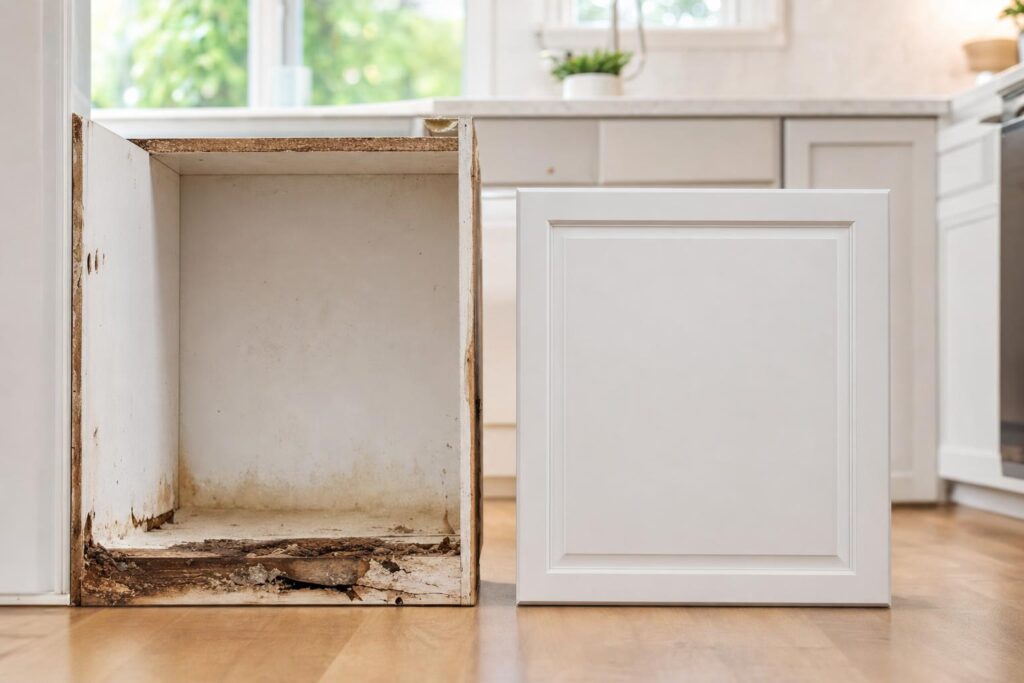
Cabinet box damage can often be repaired when it is localized and the remaining box is firm, square, and dry. Common problems include swelling, delamination, stains, loose fasteners, warped shelves, and damaged toe-kicks. A small affected area may support component repair or partial replacement, while widespread deterioration usually means you should replace damaged cabinets.
Particleboard and MDF absorb water quickly and may swell, crumble, or lose their fastener grip after prolonged exposure. Plywood and solid wood usually tolerate limited moisture better, but their veneers, joints, and edges can still delaminate, warp, or rot. The material, duration of exposure, and cabinet box damage all affect the right choice.
How do you assess cabinet box damage?
Assess the cabinet from the inside and outside before deciding whether to reface water damaged cabinets. A visual check cannot always reveal damage behind veneers or inside an enclosed sink base, so hidden moisture may require closer inspection.
- Press the bottom panel, side walls, and corners to check for softness or crumbling material.
- Inspect swollen seams, lifted laminate, dark stains, and peeling edges around the sink and plumbing.
- Check whether hinges, drawer slides, and screws still hold securely without pulling from the cabinet material.
- Examine warped shelves and damaged toe-kicks, then inspect adjacent cabinets for matching signs.
- Look at the flooring, wall areas, supply lines, drain connections, and shutoff valves for related moisture.
| Cabinet condition | Likely option | Key limitation |
|---|---|---|
| Firm box with surface staining or loose hardware | Repair and refacing | The moisture source must be corrected first |
| Local swelling at one shelf, toe-kick, or bottom panel | Component repair or partial replacement | Matching the finish and dimensions may require custom work |
| Minor veneer delamination with solid core material | Repair or refacing | Loose layers must be removed or secured before new surfaces are installed |
| Soft, crumbling, or mold-affected box across several areas | Replace damaged cabinets | Refacing will not restore structural strength |
If the existing layout still works, ReNU Kitchen can discuss custom cabinet additions or replacement components instead of removing the entire kitchen. For a broader comparison of project goals, cost, and disruption, read Cabinet Refacing vs Replacing: Which Is Right for You?. The right solution depends on the condition of each cabinet, not only its appearance.
Why is the kitchen sink cabinet often the hardest area?
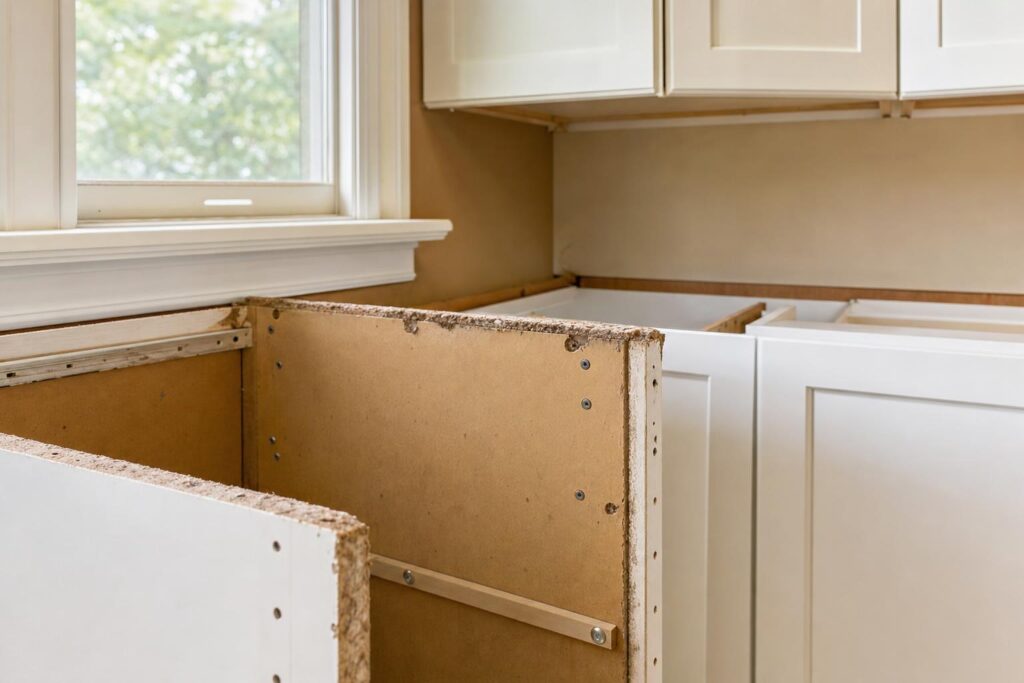
The kitchen sink cabinet is often the hardest area because it faces plumbing leaks, condensation, cleaning water, and standing moisture more often than other cabinets. Plumbing access also creates openings where water can reach the cabinet box, floor, or subfloor.
What should happen before sink-area refacing?
Identify and correct the leak or moisture source before covering any cabinet surface. A plumber may need to repair supply lines, drain connections, the garbage disposal, or the faucet. Allow affected materials to dry, then evaluate odors, mold concerns, plumbing connections, and the condition of the floor beneath the cabinet. If the source is uncertain, coordinate the cabinet decision with a plumber or another qualified professional.
- The plumbing leak must be repaired and tested before new cabinet materials are installed.
- Wet particleboard should dry fully so swelling, odor, and deterioration can be evaluated accurately.
- Mold concerns require appropriate cleaning and assessment before the cabinet area is enclosed.
- The flooring and subfloor should be inspected for soft spots, staining, or hidden water damage.
- Plumbing shutoffs and drain connections should remain accessible for future service.
When kitchen sink cabinet damage is localized, you may only need to replace the sink-base cabinet, bottom panel, or toe-kick. In some kitchens, a damaged side panel or an adjacent cabinet component can also be replaced while the surrounding cabinet boxes remain in place. The right option depends on whether the remaining structure is solid, square, dry, and securely attached.
Damage that extends into adjoining cabinet boxes, flooring, or the wall may indicate a broader moisture problem. Inspect the cabinets on both sides of the sink for swollen edges, soft bottoms, loose fasteners, and staining before choosing to reface water damaged cabinets. Replacing only the visible panel will not solve weakened cabinet box damage or an active leak.
If the surrounding cabinets remain sound, preserving the existing layout can reduce unnecessary disruption and limit the work to the sink area. You may be able to combine a localized cabinet replacement with new doors, drawer fronts, hardware, or countertops. For more planning guidance, see Cabinet Refacing Cost: What Affects Your Price? The best choice depends on the moisture source, the condition of the existing cabinets, and your broader kitchen goals.

Should you repair, reface, or replace damaged cabinets?
Repair, refacing, partial replacement, or full replacement may be the right choice based on cabinet box condition, moisture exposure, appearance goals, budget, and how much disruption you can accept. Repair suits limited damage, while refacing works when your existing layout and cabinet boxes remain sound.
Refacing replaces the doors, drawer fronts, and exterior finish without removing the cabinet boxes. It may be a practical option when the layout works but the doors and finishes look outdated. Repair can address a small swollen edge or damaged panel, while partial replacement is better when one or two boxes cannot be trusted.
| Option | Cabinet condition | Project goal |
|---|---|---|
| Repair | Limited, localized damage with no active moisture | Preserve the existing cabinet at the lowest typical scope |
| Refacing | Sound, square boxes with outdated doors or finishes | Change the appearance while keeping the layout |
| Partial replacement | One or more boxes have serious damage, but most remain reliable | Replace damaged cabinets in affected areas without rebuilding the entire kitchen |
| Full replacement | Widespread structural, sanitation, or moisture problems | Create a new layout or remove unreliable cabinetry throughout |
Replace damaged cabinets when swelling, crumbling material, mold, soft panels, or repeated moisture exposure makes a box structurally or hygienically unreliable. Full replacement usually takes more time, costs more, and creates greater disruption than refacing, but it may be necessary when the existing layout no longer suits your needs.
Start by stopping the moisture source, then document the affected areas before cleanup changes what you can see. Inspect the cabinet interiors, bottoms, side panels, and nearby flooring, and compare the repair scope with your layout and budget goals. For cost context, review Cost to Reface Kitchen Cabinets: Pricing and Estimates before requesting an estimate.
What information should you bring to an estimate?
Bring photos of swollen areas, plumbing, flooring, cabinet interiors, doors, and adjacent boxes. Note when the damage occurred, whether the leak was repaired, and which parts feel soft or unstable. Measurements, layout goals, preferred materials, hardware choices, and countertop plans help define the right choice.
- Stop the leak and identify whether moisture is still reaching the cabinets.
- Photograph visible damage and the surrounding plumbing, flooring, and boxes.
- Note soft, unstable, swollen, or crumbling areas inside and outside the cabinets.
- Record your preferred layout, materials, hardware, and countertop plans.
- Request a professional estimate that compares repair, refacing, partial replacement, and full replacement.
ReNU Kitchen brings more than 26 years of experience and custom craftsmanship to cabinet refacing and related upgrades. The company provides free estimates across New Jersey and parts of New York, helping you compare practical options with less disruption than a complete kitchen rebuild may require.
Frequently asked questions
Can water-damaged kitchen cabinets be refaced?
Water-damaged kitchen cabinets can be refaced when their cabinet boxes are dry, solid, square, and structurally reliable. Refacing changes exterior surfaces, doors, and drawer fronts; it does not restore severely swollen or crumbling cabinet material. The moisture source must be corrected before any refacing work begins.
When should I replace a water-damaged cabinet box?
You should consider replacing a water-damaged cabinet box when the material is soft, crumbling, badly warped, mold-affected, or unable to hold hinges and fasteners. Replacement is also appropriate when damage extends through the bottom, sides, or back, particularly around a sink or plumbing leak.
Is cabinet repair possible after a sink leak?
Cabinet repair may be possible after a sink leak if damage is limited to a toe-kick, bottom panel, hinge area, or other replaceable component. First repair the plumbing, dry the cabinet and surrounding floor, and inspect for hidden deterioration. A professional can then recommend repair, partial replacement, or refacing.
Does refacing preserve my existing kitchen layout?
Yes, cabinet refacing generally preserves your existing kitchen layout because the cabinet boxes remain in place. It can update doors, drawer fronts, veneer, hardware, and selected countertops without the disruption of removing every cabinet. This approach may be the right choice when the current storage arrangement works well.
Should you repair, reface, or replace damaged cabinets?
Ready to transform your kitchen? Contact Renu Kitchen for your free estimate at (732) 890-9911.