
Cabinet Refacing Contractor Questions to Ask Before Hiring
The right cabinet refacing contractor questions cover experience, materials, project scope, schedule, warranty, communication, and the cabinet refacing estimate. Asking these questions helps you compare craftsmanship and total value before choosing a professional for your existing kitchen.
Key takeaways
- A qualified refacing contractor should explain how cabinet boxes, doors, drawer fronts, and hardware will be handled.
- The written cabinet refacing estimate should identify materials, labor, included services, exclusions, and payment terms.
- A contractor should inspect the condition of your existing cabinet boxes before recommending refacing.
- A realistic schedule should address preparation, installation, countertop or hardware work, and final cleanup.
- Warranty coverage should state what is protected, how long coverage lasts, and who handles service requests.
What Experience Should a Cabinet Refacing Contractor Have?
A qualified cabinet refacing contractor should have specialized experience, strong local references, proper insurance, and a proven process for measuring, fabricating, installing, and finishing kitchens with existing cabinet boxes.
Ask how long the company has focused on cabinet refacing, not only general remodeling. Refacing requires careful work around fixed layouts, walls, appliances, and cabinet boxes that must remain level and structurally sound. Experience helps the contractor identify problems before installation and recommend options that fit your kitchen.
Request photos of completed kitchens with layouts, materials, and design goals similar to yours. Ask who handles each part of the project, including measurements, door and drawer-front fabrication, installation, and finishing. The answer should be clear whether the work is performed by the company’s own team or outside crews.
Before you hire a cabinet refacing contractor, request recent local references, review customer feedback, and confirm proof of liability insurance. Ask which licensing requirements apply in your area and whether the company meets them. For additional guidance, review Kitchen Cabinet Refacing Company: How to Choose with Confidence.
How Can You Verify Craftsmanship Before Hiring?
Project photos can reveal more than a company’s years in business. Look for consistent door gaps, even edge treatment, straight alignment, and clean finishing around corners, walls, and appliances. Ask whether the company provides references from recent projects in your area.
- Project photos should show even spacing between doors and drawer fronts across the entire kitchen.
- Finished cabinet edges should look smooth and consistent at corners, sides, and exposed panels.
- Doors and drawers should align correctly without rubbing or uneven reveals.
- The contractor should explain installation details, materials, and finishing methods clearly.
- References should come from recent local homeowners with comparable kitchen projects.
Clear answers about preparation and installation matter more than a vague claim of experience. The right contractor can explain how measurements are checked, how surfaces are prepared, and how the finished refacing will work with your existing layout.

Which Materials and Finishes Are Included?
Ask which refacing material, finish, edge treatment, and accessories are included before you hire a cabinet refacing contractor. These details affect your kitchen’s appearance, maintenance, durability, and final cabinet refacing estimate.
Cabinet refacing applies a new exterior veneer or laminate to your existing cabinet boxes while replacing the doors and drawer fronts. Ask whether the contractor uses wood veneer, rigid thermofoil, laminate, or another material, and where each option is appropriate for your kitchen.
| Material | Appearance and maintenance | Durability and ideal use |
|---|---|---|
| Wood veneer | Natural wood grain | wipe clean and may need careful moisture control |
| Rigid thermofoil | Smooth, consistent color | easy to clean |
| Laminate | Broad range of colors and patterns | low-maintenance surface |
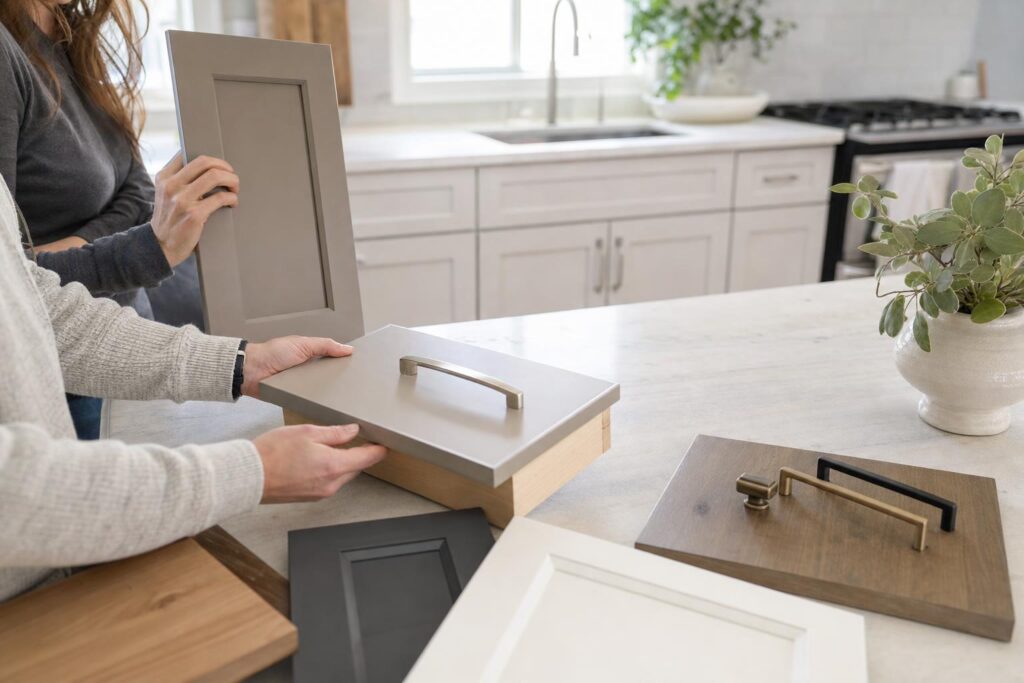
Your questions for kitchen contractor should also cover the finish, color, edge details, door style, drawer front style, and hardware options. Request physical samples when possible, since lighting can change how a color or wood grain looks in your kitchen.
- Confirm how seams and outside corners will be joined so the finished surfaces look consistent.
- Ask whether exposed cabinet sides, toe kicks, and fillers receive the same material as the doors.
- Confirm whether cabinet interiors are included or remain unchanged.
- Ask whether countertop upgrades, hardware replacement, and custom cabinet additions are included or priced separately.
- Request each selected material and finish in writing with the cabinet refacing estimate.
The contractor should explain how the existing cabinet boxes will be prepared and where each material works best. For a broader comparison of project types, review Cabinet Refacing vs Refinishing: Which Is Right? before choosing your approach. Clear material details help you compare options and avoid unexpected changes during installation.
What Exactly Will the Refacing Project Include?
The refacing project should define cabinet condition, included components, layout limits, preparation, cleanup, exclusions, and possible change-order costs before you sign.
Can Refacing Fix Every Kitchen Cabinet Problem?
Refacing improves the visible surfaces of sound cabinet boxes, but it cannot repair severely damaged or unstable structures. Ask the contractor to inspect for water damage, swelling, loose joints, and other problems before recommending refacing. If a box cannot support a durable result, replacement may be the right choice.
Drawer front replacement can address worn or mismatched drawer faces, while hardware replacement can update hinges, pulls, and knobs without changing the boxes. Custom additions may solve a storage need when the existing layout lacks space. Review Custom Cabinets During Refacing: Is It Worth It? if you are considering added cabinetry.
- Ask whether the estimate includes cabinet doors, drawer fronts, exposed ends, moldings, and toe kicks.
- Confirm whether hinges, pulls, and soft-close hardware are included or priced separately.
- Verify that the existing layout will remain unchanged and identify any custom cabinet additions under consideration.
- Ask how plumbing, appliances, countertops, flooring, and electrical work could limit the scope or require other trades.
- Require written details for surface preparation, protection, cleanup, disposal, exclusions, and change-order costs.
A clear refacing contractor checklist should also explain what happens if hidden damage appears after work begins. Ask whether added repairs require your approval before materials or labor are ordered. This prevents a cabinet refacing estimate from changing without notice and gives you a practical way to compare contractors. A detailed scope is one of the most useful questions for a kitchen contractor because it connects the finished appearance to the work included.
How Long Will the Work Take and What Will It Cost?
Ask for a written schedule and a detailed cabinet refacing estimate that show each project phase, total cost, possible delays, and payment terms before you hire a contractor.
The schedule should separate measuring, ordering, preparation, installation, and final inspection. Ask how long each phase usually takes and when work will begin. Confirm how much access your kitchen needs during preparation and installation so you can plan for daily disruption.
Request separate pricing for labor, cabinet materials, drawer fronts, hardware, disposal, taxes, and optional upgrades. Compare estimates based on the same scope and product specifications, not the lowest number alone. A lower price may leave out installation work, finish details, or necessary repairs.
What Should a Written Estimate Show?
Look for cabinet measurements, product descriptions, finish selections, quantities, labor charges, and a clear total price. The estimate should also identify allowances, which are budget amounts for items not yet selected, along with exclusions, expiration dates, and possible additional charges. For more planning guidance, review Cost to Reface Kitchen Cabinets: Pricing and Estimates. Ask how long the estimate remains valid if material costs or your project decisions change.
Ask what could delay the work, including material availability, hidden damage inside the cabinet boxes, countertop work, or layout changes. Confirm whether repairs or changes require written approval before additional work begins. This helps you avoid surprises when the existing kitchen needs more work than expected.
Before signing, confirm the deposit, payment milestones, cancellation terms, and final payment requirements. Ask how approved changes are documented and priced. Clear records give you and the contractor the same understanding of the work, schedule, and total cost.

What Warranty and Communication Should You Expect?
You should expect written warranty terms, a clear project contact, regular updates, responsive service, and a final walkthrough before the contractor considers the work complete.
Ask what the workmanship and material warranties cover and how long each one lasts. Confirm whether coverage includes peeling or lifting surfaces, hardware failure, door and drawer alignment issues, and edge problems, or only selected defects. Request the warranty in writing with the process for reporting a concern.
Ask who will manage your project and how updates will be shared. Confirm whether questions and changes will be handled by phone, email, text, or an online system, and ask how quickly you can expect a response. Before final payment, request a walkthrough to inspect the doors, drawer fronts, hardware, edges, cleanup, and any outstanding items.
How Do You Choose the Right Contractor After Comparing Answers?
Compare each contractor’s clarity, documented scope, material quality, schedule confidence, warranty terms, and communication standards. The right professional should explain recommendations that fit the condition of your existing kitchen and support your goals, whether you want a refreshed appearance, better storage, or limited disruption.
- Choose a contractor who explains which existing cabinet boxes can be refaced and which may need additional work.
- Compare written materials, finish options, hardware details, and installation steps rather than comparing price alone.
- Select a contractor who gives a realistic schedule and explains how delays or project changes will be handled.
- Confirm that warranty terms identify coverage periods, exclusions, and the process for requesting service.
- Choose a project contact who answers questions clearly and keeps you informed throughout the work.
Renu Kitchen has more than 26 years of experience refacing kitchens and provides experienced guidance for homeowners across New Jersey and parts of New York. Free estimates make it easier to discuss your cabinet condition, options, and project goals before making a decision. Ready to transform your kitchen? Contact us for your free estimate.
Frequently asked questions
What is the most important question to ask a cabinet refacing contractor?
Ask the contractor to explain exactly what will be refaced, replaced, repaired, and excluded. This answer should cover cabinet boxes, doors, drawer fronts, exposed sides, hardware, preparation, cleanup, and potential change orders. A detailed written scope helps you compare contractors and avoid misunderstandings about the finished kitchen.
How many estimates should you get for cabinet refacing?
Many homeowners compare two or three detailed estimates for cabinet refacing. Each estimate should use similar measurements, materials, door styles, hardware selections, labor assumptions, and warranty terms. Comparing matching scopes is more useful than comparing totals alone because a lower price may exclude important preparation or installation work.
What should a cabinet refacing warranty include?
A cabinet refacing warranty should identify the covered materials and workmanship, coverage period, exclusions, and process for requesting service. Ask whether it addresses issues such as lifting, peeling, defective components, or hardware problems. The contractor should also explain whether manufacturer warranties and installation warranties are separate.
Is cabinet refacing suitable for every kitchen?
Cabinet refacing is usually suitable when existing cabinet boxes are structurally sound and the homeowner wants to keep the current layout. It may not be appropriate when boxes have significant water damage, unstable joints, or serious deterioration. A professional inspection can determine whether refacing, partial replacement, or new cabinets is the right choice.
Choose the Refacing Professional That Fits Your Kitchen
Ready to transform your kitchen? Contact us for your free estimate.